
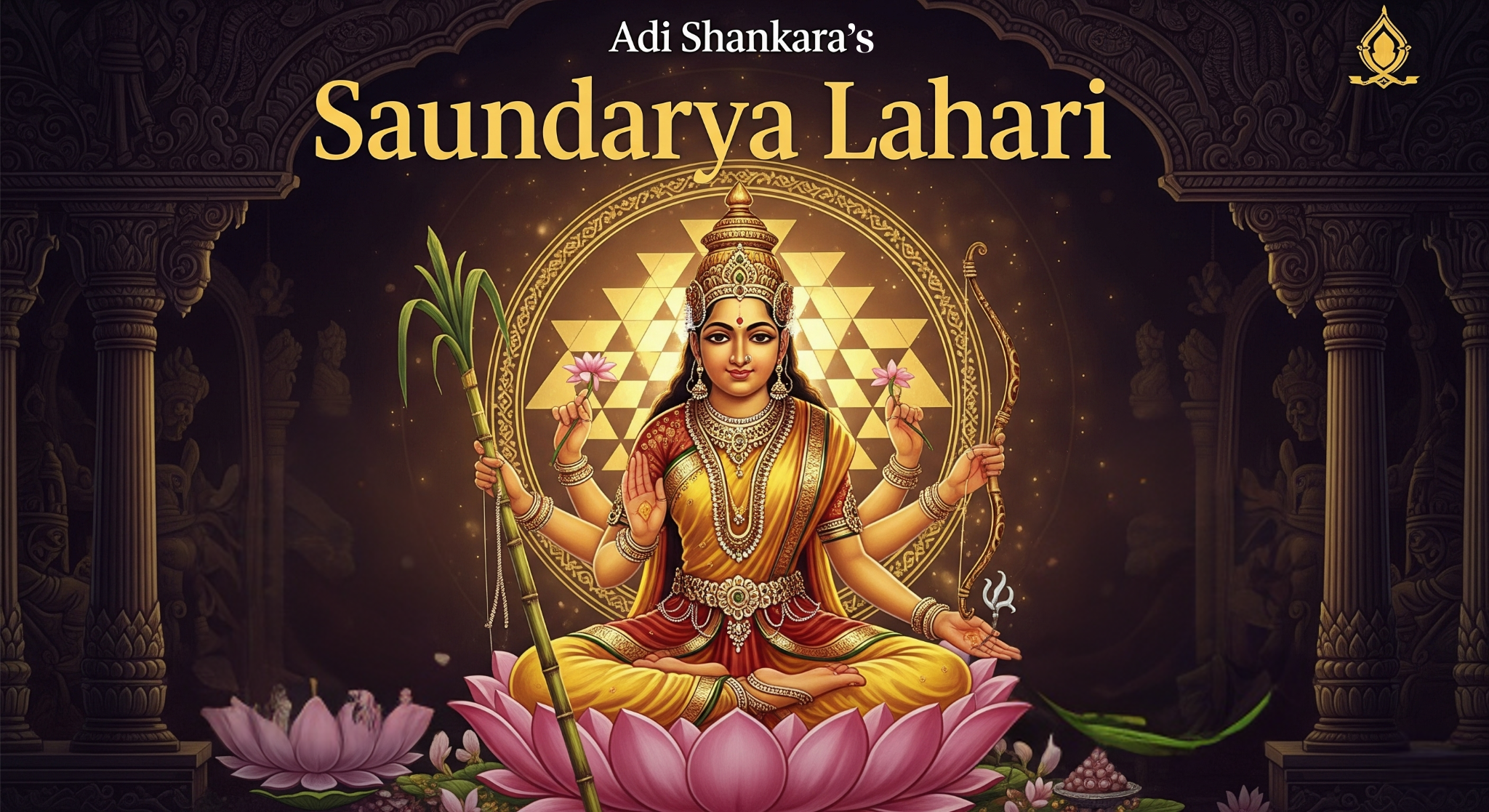
शिवः शक्त्या युक्तो यदि भवति शक्तः प्रभवितुं न चेदेवं देवो न खलु कुशलः स्पन्दितुमपि। अतस्त्वामाराध्यां हरिहरविरिञ्चादिभिरपि प्रणन्तुं स्तोतुं वा कथमकृतपुण्यः प्रभवति॥
śivaḥ śaktyā yukto yadi bhavati śaktaḥ prabhavituṁ na cēdevaṁ dēvo na khalu kuśalaḥ spanditum api। atas tvām ārādhyāṁ hari-hara-viriñcādibhir api praṇantuṁ stōtuṁ vā katham akṛta-puṇyaḥ prabhavati॥
Translation
Shiva, united with Shakti, becomes capable of creating; otherwise, the god is not even skilled to move. Therefore, how can one without merit bow to or praise you, who are worshipped even by Vishnu, Shiva, Brahma, and others?
Word by word
- śivaḥ
- Shiva
- śaktyā
- with Shakti
- yuktaḥ
- united
- yadi
- if
- bhavati
- becomes
- śaktaḥ
- capable
- prabhavituṁ
- to create
- na
- not
- cēt
- if
- evaṁ
- thus
- dēvaḥ
- god
- khalu
- indeed
- kuśalaḥ
- skilled
- spanditum
- to move
- api
- even
- ataḥ
- therefore
- tvām
- you
- ārādhyāṁ
- worthy of worship
- hari
- Vishnu
- hara
- Shiva
- viriñca
- Brahma
- ādibhiḥ
- and others
- praṇantuṁ
- to bow
- stōtuṁ
- to praise
- vā
- or
- katham
- how
- akṛta-puṇyaḥ
- one without merit
- prabhavati
- is able
Meaning
This opening verse establishes the primacy of Shakti, the divine feminine energy, as the source of all cosmic activity. Shiva, representing consciousness, is inert without Shakti's dynamic power. The Goddess, as Shakti, is thus the ultimate object of worship, revered by the Trimurti (Vishnu, Shiva, Brahma). Only those with accumulated merit (puṇya) can worship or praise her, emphasizing her transcendence and the spiritual preparation required for devotion. In the Śrīvidyā tradition, this verse underscores Shakti's role as the cosmic mother and the foundation of all existence, setting the tone for the text's Shakta philosophy.