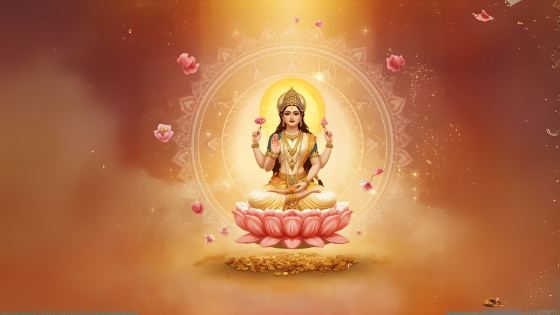
The festival of Diwali, with its radiant lights and joyous celebrations, brings the faithful together to honour Goddess Lakshmi, the embodiment of prosperity and abundance. As the full moon of Kartik gives way to the new moon, homes across India and beyond glow with diyas, symbolising the triumph of light over darkness. At the heart of this observance lies Lakshmi Puja, a ritual that invokes the divine mother of wealth, not merely for material gain, but for the deeper blessings of harmony, virtue, and spiritual fulfilment. In Sanatana Dharma, Lakshmi stands as more than a bestower of riches; she represents an archetype that weaves together the threads of creation, sustenance, and transcendence. Through her stories and symbols, we glimpse profound truths about the nature of prosperity in a world of contrasts.
Lakshmi's emergence from the churning of the milk ocean, known as the Samudra Manthan, captures the essence of her archetype in vivid detail. This ancient tale, recounted in the Puranas, unfolds as a cosmic endeavour where the devas, or demi-gods, and asuras, the demons, unite in a monumental act of cooperation. The ocean of milk, vast and unyielding, yields its treasures only after relentless effort. The devas and asuras, bound by a temporary alliance, use the serpent Vasuki as a rope and Mount Mandara as a churning rod, labouring tirelessly to extract the nectar of immortality, Amrita. From this toil arises Lakshmi, radiant and resplendent, stepping forth on a lotus, her presence heralding abundance. This narrative illustrates a fundamental principle: wealth does not materialise from idleness or conflict alone, but from organised effort, mutual collaboration, and persistent work. In the churning, opposites—divine and demonic—find common purpose, reminding us that true prosperity blooms from unity amid diversity.
The Samudra Manthan symbolises the human condition, where challenges demand collective resolve. The devas, weakened by a curse, and the asuras, driven by ambition, represent the polarities within society and the self. Their partnership, though fraught with tension, produces not just nectar but a cascade of divine gifts: the wish-fulfilling cow Kamadhenu, the celestial tree Kalpavriksha, the moon Chandra, and Lakshmi herself. Vedic texts, such as the Vishnu Purana, describe this event as a metaphor for the soul's journey, where inner turmoil yields spiritual riches through disciplined action. Lakshmi's birth from this process underscores that abundance requires structure and harmony. In contemporary terms, this resonates with economic theories that emphasise cooperative models, like community-driven enterprises or sustainable development initiatives, where shared labour fosters lasting growth. During Lakshmi Puja, devotees offer sweets and grains, echoing the ocean's bounty, invoking her grace for endeavours that blend effort with ethical intent.
Yet, Lakshmi's archetype extends beyond mere acquisition; it speaks to the heart's deepest yearnings and the soul's quiet wisdom. Every being, from sage to commoner, seeks her favour, drawn to the promise of comfort and security she embodies. Scriptures abound with tales of kings and ascetics alike beseeching her for fortune. The Vishnu Purana recounts how even Indra, king of the gods, falters without her presence, his celestial realm dimming in her absence. This universal desire reflects humanity's innate pull toward fulfilment, a longing etched in the Rig Veda, where hymns praise her as Sri, the auspicious one who brings light to shadowed lives. In tantric traditions, Lakshmi symbolises the flow of prana, the vital energy that sustains creation, making her indispensable to yogic practices that harmonise body and spirit.
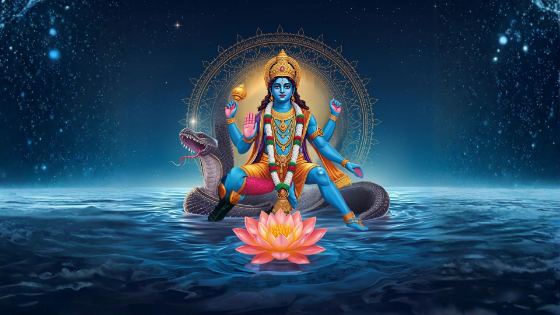
Paradoxically, while all pursue Lakshmi, she yearns solely for Lord Vishnu, the preserver of the cosmos, whose essence is pure goodness. Vishnu, reclining on the serpent Ananta in the ocean of milk, remains utterly detached, his heart unmoved by the world's dramas. The Bhagavata Purana narrates how, during the churning, Lakshmi scans the assembly and chooses Vishnu, drawn to his serene indifference. He neither grasps for her nor rejects the universe's play; his love flows without possession, a model of equanimity. This dynamic reveals a timeless truth: true wealth eludes those who chase it desperately, favouring instead the steady soul grounded in virtue. In Vedanta, Vishnu represents the sattva guna, the quality of clarity and balance, contrasting Lakshmi's rajas, the active force of prosperity. Their union, eternal and harmonious, teaches that abundance thrives in detachment, much like the yogi who seeks union with the divine without clinging to outcomes.
Lakshmi's abode on the lotus flower further enriches her archetype, symbolising purity rising from impurity. The lotus, rooted in mud yet blooming untainted, mirrors the journey of wealth through the world's imperfections. The mud evokes the filth of material existence—greed, inequality, and transience—while the flower's pristine petals signify transcendence. Texts like the Lakshmi Tantra describe her seated on this bloom, flanked by elephants showering water, denoting abundance purified by grace. In yoga, the lotus aligns with the sahasrara chakra, the crown centre of enlightenment, where material and spiritual converge. During Lakshmi Puja, devotees place lotuses at her feet, aspiring to cultivate inner purity amid life's messiness. This symbol reminds us that genuine prosperity demands ethical foundations; wealth built on exploitation withers, while that nurtured in righteousness endures.
Lakshmi Puja, observed during Diwali, invites reflection on these attributes. As night falls, households light lamps to welcome her, chanting mantras from the Sri Sukta of the Rig Veda, which invoke her as the source of all auspiciousness. Families clean their homes, symbolising the clearing of inner clutter, and offer rice, coins, and sweets, representing labour's fruits. In Bengal, the ritual extends to Kojagori Lakshmi Puja under the autumn moon, where communities gather for feasting and storytelling, emphasising shared prosperity. Tantric practices incorporate yantras, geometric diagrams inscribed with her seed mantra "Shrim," to channel her energy for holistic well-being. These observances, rooted in ancient customs, adapt to modern life, with virtual pujas for diaspora communities, blending tradition with accessibility.
The archetype of Lakshmi challenges superficial notions of wealth. In a global economy marked by disparity, her story calls for equitable distribution, echoing Vedic ideals of dana, or selfless giving. The Mahabharata illustrates this through tales where kings blessed by Lakshmi falter without dharma, underscoring that prosperity without righteousness breeds downfall. In Vedanta, Lakshmi as Vishnu's consort symbolises the interdependence of material and spiritual life; one without the other leads to imbalance. Yogic texts like the Hatha Yoga Pradipika link her blessings to pranayama, where controlled breath awakens inner abundance, freeing one from external dependencies.
Lakshmi's forms vary across traditions, enriching her archetype. As Ashta Lakshmi, she manifests in eight aspects—wealth, knowledge, courage, family, progeny, victory, food, and wisdom—each addressing life's facets. In South India, she appears as Kamalalaya, residing in Vishnu's heart, emphasising devotion over ritual. Tantric lineages, such as the Sri Vidya, worship her as Tripura Sundari, the beauty of the three worlds, integrating her with kundalini yoga for transformative power. These variations highlight her universality, adapting to cultural contexts while preserving core principles.
During Lakshmi Puja, the act of invocation becomes a meditation on impermanence. Lamps flicker, reminding us of life's transience, yet their light endures, symbolising eternal grace. Families share meals, fostering bonds that mirror the churning's cooperation. Children learn through stories of Lakshmi's choice of Vishnu, imbibing values of humility and detachment. In urban settings, where materialism reigns, this puja serves as a counterbalance, encouraging reflection on wealth's true measure—contentment over accumulation.
Lakshmi's narrative in the Ramayana, where she aids Rama's exile, portrays her as a supporter of dharma, granting strength in adversity. This resonates with modern seekers facing economic uncertainty or personal trials, offering solace that grace accompanies the righteous. In tantra, her worship through homas, fire rituals, purifies karma, aligning material pursuits with spiritual evolution. Vedantic commentaries, like those of Ramanuja, view her as the soul's mediator, bridging human frailty with divine compassion.
As Diwali approaches, Lakshmi Puja calls us to embody her archetype. Organisation in daily routines, cooperation in relationships, and labour in pursuits invite her presence. Her desire for Vishnu teaches us to cultivate inner goodness, indifferent to outcomes yet engaged in duty. The lotus urges purity amid chaos, reminding that wealth rooted in virtue blossoms eternally. In this sacred rite, we honour not just abundance, but the grace that sustains the soul through life's churning waves.
This exploration of the Lakshmi archetype illuminates the path to true prosperity through virtue, purity, and divine grace, weaving ancient wisdom into the fabric of modern life.